

Not every security need is permanent. A development site during construction. A community festival running over a holiday period. A vacant building between tenants. A council car park after a string of incidents. These are situations where security risks are real but temporary, and installing a permanent camera system doesn’t make practical or financial sense.
Mobile surveillance units are designed for exactly this gap. They provide monitored CCTV coverage that deploys quickly, operates independently, and moves to the next site when the job is done. If you’ve got a temporary security problem and you’re weighing up your options, this guide explains how mobile surveillance works and when it’s the right choice.
How It Works
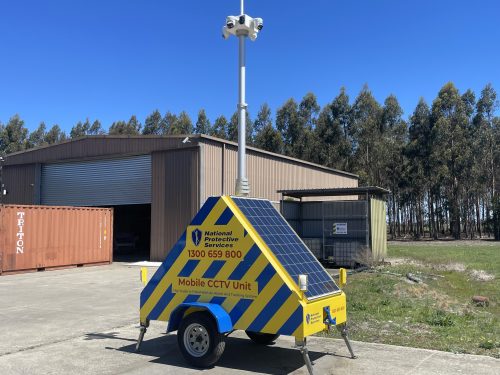
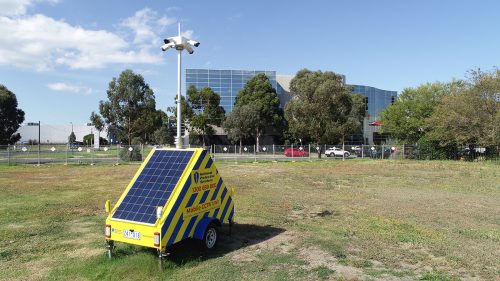
Our mobile surveillance systems are trailer-mounted camera units equipped with solar panels, battery storage, and cellular data connections. They don’t need mains power, a fixed internet connection, or any existing infrastructure on site. They operate autonomously through cloudy periods and power interruptions, providing reliable coverage around the clock.
The trailers provide elevated camera coverage and can be repositioned as a project progresses or a site layout changes. They connect directly to our Grade A monitoring centre, where operators view live footage, verify alerts, adjust camera angles, and coordinate response in real time.
This is where the system earns its value. When cameras detect activity, our monitoring operators assess every alert, distinguishing genuine security events from routine activity or environmental triggers. If the threat is real, they dispatch patrol officers, notify site contacts, or escalate to emergency services. If it’s not, they log it and refine the system to reduce future false activations. This prevents alarm fatigue and ensures every response is proportionate and actionable, not automated and unchecked.
When Mobile Surveillance Makes Sense
Mobile surveillance is commonly used on construction sites, vacant properties, infrastructure projects, storage yards, and temporary facilities. These environments often lack permanent power, connectivity, or staffing and may change rapidly over time.
The common thread is a security need that has a defined timeframe or a site that lacks the infrastructure for a fixed system. If your risk is ongoing and your site has power and connectivity, a permanent CCTV installation is usually more cost-effective over the long term.
Beyond Trailers: Temporary Alarm and CCTV Systems
Mobile surveillance isn’t limited to trailer-mounted units. We also install temporary alarm and CCTV systems on existing structures: fencing, scaffolding, site offices, and shipping containers. These systems suit construction projects, short-term leases, and any site that needs security coverage without permanent installation.
The choice between a trailer unit and a temporary fixed system depends on how often the coverage area changes. If the site layout is evolving week to week, trailers offer the flexibility to reposition as needed. If the coverage area is stable for the duration of the project, a temporary system mounted on existing infrastructure may be simpler and more cost-effective.
What Mobile Surveillance Can’t Do
Autonomous security does not replace judgement or physical response in all situations. Weather, site layout, connectivity, and human behaviour can all affect performance.
If someone ignores the cameras and enters your site, the system can detect them, alert the monitoring centre, and trigger a coordinated response. But it can’t physically stop them. For sites where immediate on-the-ground intervention is critical, mobile surveillance works best alongside mobile patrols or on-site officers.
For this reason, we design every system with clear use cases, defined response protocols, and escalation paths to patrols or on-site personnel when required. The technology is part of the program, not the whole of it.
How It Compares to Other Options
- Permanent CCTV: A permanent system is more cost-effective if the risk is ongoing and the site has infrastructure. Mobile surveillance is best suited when the risk is temporary, the site is off-grid, or you need coverage now rather than in the time it takes to design and install a fixed system.
- Mobile patrols: Patrols provide periodic physical checks but leave gaps between visits. Surveillance provides continuous visual monitoring but no physical presence. The strongest approach for high-value temporary sites combines both: surveillance detects, mobile patrols respond.
- Static guarding: Round-the-clock guarding provides immediate physical response but at a significantly higher cost. Monitored mobile surveillance provides continuous coverage at a fraction of the cost, though without the same immediacy of on-site response. For many temporary sites, the combination of surveillance plus patrol response achieves a comparable security outcome at a lower total cost.
How We Decide Whether It’s Right for Your Site
We assess site risk, operational requirements, duration of use, and response expectations before recommending autonomous security. The decision is based on practicality and effectiveness, not technology alone.
Some questions that shape the recommendation:
- How long is the risk period?
- Does the site have power and internet?
- What happens when the cameras detect something?
- Can the system be repositioned?
Where autonomous systems are suitable, we configure them to integrate with our monitoring and response services to ensure coverage is reliable and accountable.
If you would like guidance on reviewing your security setup or arranging patrol and monitoring services over the holiday period, National Protective Services can help.
Find out more about our Mobile and Autonomous Security Services or contact our team at info@natprot.com.au or call 1300 659 800.