

If you manage security across multiple facilities, the challenge is usually not a lack of equipment. It is the lack of consistency between sites. One location may have an older camera system, another may have access control that is only partly centralised, and a third may rely on a different patrol or monitoring arrangement altogether.
That creates more coordination work than most teams need. Instead of managing one coherent security program, you can end up managing a patchwork of systems, providers, and reporting formats.
The Multi-site Problem
Every site has its own risk profile, operating hours, layout, and access needs. A library, a leisure centre, a healthcare site, and a warehouse will not need identical security coverage. The problem usually starts when those sites were set up at different times, by different providers, with different standards.
Over time, that can lead to fragmented reporting, inconsistent system performance, and delays when changes need to be made. A staff member moves sites, and their access record is not updated everywhere at once. An incident happens after hours and the response depends on which provider is responsible for that location. Senior management asks for a portfolio-wide view and the report has to be assembled manually.
What Consistency Looks Like
Consistency does not mean every site needs the same equipment. It means there is a common standard for oversight, reporting, and response.
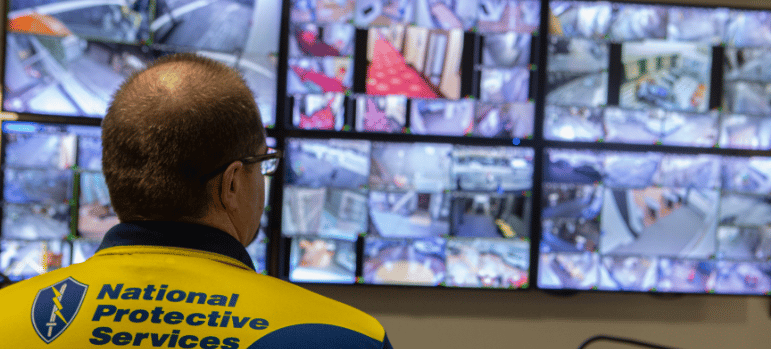
A well-run multi-site program often uses a central approach to access control, so credentials can be issued, updated, and revoked more efficiently across the portfolio. CCTV can still be tailored to each site’s layout and risk, while feeding into a common reporting or monitoring framework where that is practical.
The same principle applies to alarms and patrols. In a coordinated model, the monitoring team knows the site, understands the expected activity, and can follow site-specific response steps rather than treating every location the same. That makes the response more relevant and the reporting more useful.

Patrols as Part of the Program
For some organisations, mobile patrols add value by providing physical verification across sites that do not need a permanent guard. A rotating patrol arrangement can help check perimeters, access points, and verified alarms across multiple locations.
Patrols are most effective when they work alongside the rest of the security setup. If monitoring, CCTV, access control, and patrol response are connected in a sensible way, the result is less duplication and fewer gaps.
Moving From Patchwork to Program
The transition does not need to happen all at once. A practical starting point is a review of what is already in place: which systems are current, which are outdated, where the biggest gaps are, and which sites create the most operational friction.
Many organisations begin by standardising reporting, centralising access control where possible, and connecting alarms to a single monitoring arrangement. CCTV upgrades can then be scheduled as systems age or as higher-risk sites justify the investment.
The goal is not to rip everything out and start over. It is to move toward a security structure that is easier to manage, easier to report on, and more consistent across the portfolio.
Need Help Bringing Your Sites Under One Program?
We provide CCTV, access control, alarm monitoring, and mobile patrols across multiple sites, so we review what each location already has before recommending any changes. Sometimes the right step is standardising reporting. Sometimes it is centralising access control. Sometimes it is a staged program across the whole portfolio.
If you would like help reviewing security arrangements across your sites, we can help.
Find out more about our Electronic Security and CCTV Services or contact our team at info@natprot.com.au or call 1300 659 800.